
Many people know what their birthstone is, and may even have a treasured piece of jewellery featuring their birthstone.
So, what exactly are birthstones?
Birthstones are gemstones that are "assigned" to each of the 12 months of the year. Each month has its unique stone or stones, and it can be fun to wear and "represent" your special month.
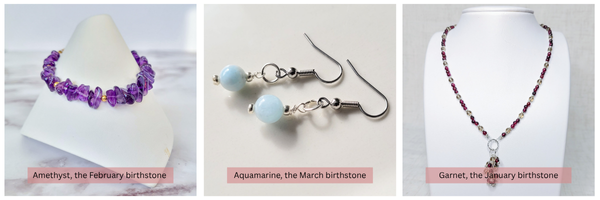
But where do they come from?
One of the earliest concepts of birthstones in Western tradition was inspired by a story in the Bible about a breastplate set with twelve different gemstones. A Roman scholar, Titus Flavius Josephus, observed that the twelve stones in the story corresponded with the twelve months of the year, and matched each stone to a month. Because of how gemstones were named at that time, and variation in translations, it's not clear what all of the stones were. Known stones include carnelian, beryl, agate, amethyst, topaz, onyx, and jasper.
However, different cultures and countries created their own lists of birthstones over the years and there was no single agreed-upon set of gems.
What are each of the birthstones now?
In 1912, the American National Retail Jeweler's Association (now known as Jewelers of America) released their list of "modern birthstones." Over the years, other gemstones have been added to months. While some still have just one gem (such as February), others, like December, have three to choose from!
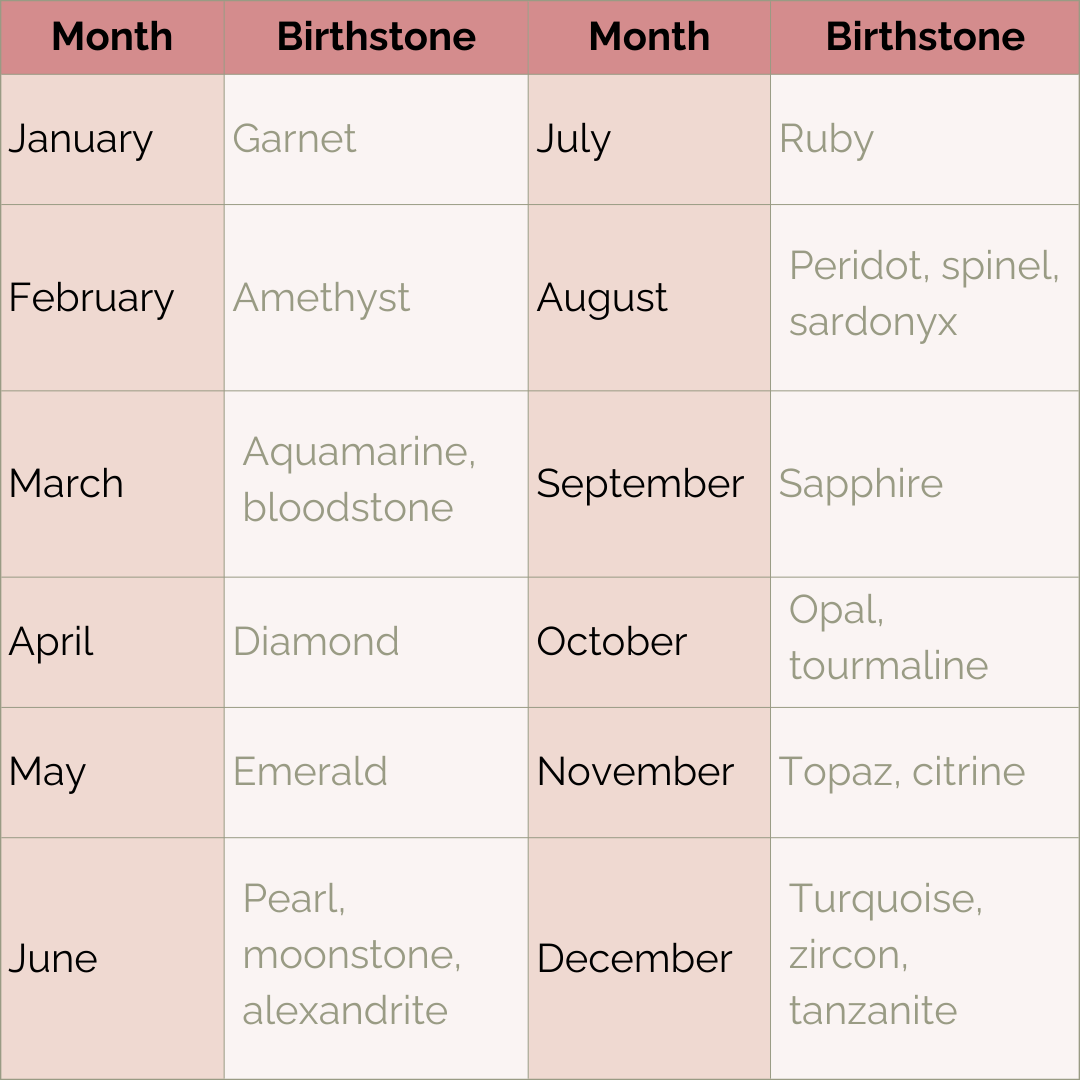
The current list of birthstones, as set by Jewelers of America.
January: We start off the year with garnet, a gemstone that’s actually more than one gemstone! Garnet is actually a group of minerals with similar crystal structures. Get the whole story in our article on garnets.
February: Next up is the fabulously purple amethyst! Amethyst is a purple form of quartz that ranges from pale lilac to dark purple. Enjoy our deep dive into this regally popular stone.
March: March is the first month to get more than one birthstone. Aquamarine is a translucent pale blue mineral in the beryl family, while bloodstone, also known as heliotrope, is dark green and opaque, with red iron oxide flecks which resemble the colour of blood. Read more on aquamarine here!
April: Diamonds might be a girl’s best friend, but especially for those born in April! As an affordable alternative, consider substituting clear quartz, or Herkimer diamonds.
May: Another mineral in the beryl family, emeralds are the birthstone for May. With their unique green colour, they’re an unforgettable gemstone.
June: June babies are spoiled for choice! Pearls, while not strictly a mineral, are the most well-known birthstone for this month. Other choices include shimmery moonstone and alexandrite.
July: The heat of July brings us the fiery ruby. A mineral in the corundum family, rubies are prized gemstones for their brilliant red colour.
August: Almost the opposite of July, August babies get the cheerful apple-green peridot. The gem-quality version of olivine, peridot is light, bright green tending towards a warm slightly yellow cast. Alternate gemstones for August are spinel and sardonyx.
September: This month gets the wildly popular sapphire. Sapphire is another mineral in the corundum family. While it’s best known as a blue gemstone, it can occur in a variety of colours, save one - red.
October: October babies get to choose between two birthstones - opal and tourmaline. Both can occur in a variety of colours, giving October babies a lot of choice.
November: The two birthstones for November have more colour in common than some other months. Topaz occurs most commonly as colorless, pale blue, yellow, orange, brown, pink, and imperial (golden-orange with reddish overtones); those warm colours are also found in citrine, with warm golden amber hues.
December: Ending the year with three options, December babies get to choose between lustrous blue-green turquoise, glittering zircon, and beautiful blue-indigo tanzanite.
